
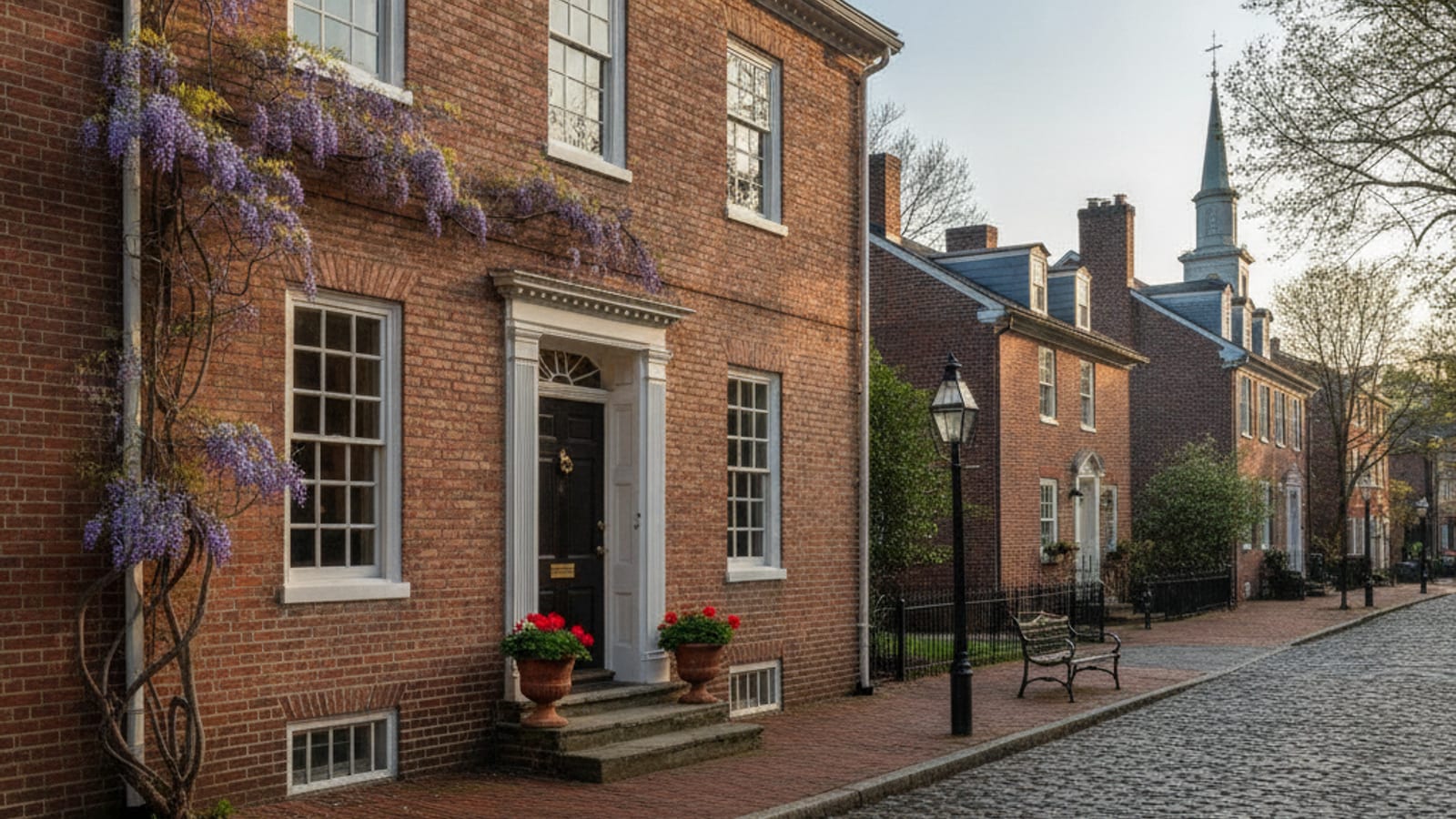
Buying a historic home in Old Town Alexandria is one of the most rewarding real estate decisions in the Washington, DC metro — and one of the most layered. The district's brick rowhouses, Federal-style townhomes, and Georgian manors carry genuine 18th- and 19th-century provenance. They also come with a regulatory framework, a waterfront floodplain, and structural particularities that demand careful due diligence before any offer is written. This guide walks through what every serious buyer needs to understand about the Old and Historic Alexandria District, the Board of Architectural Review, flood-insurance obligations, and the inspections that matter most in a century-old or older home.
What Is the Old and Historic Alexandria District?
The Old and Historic Alexandria District is the City of Alexandria's locally designated historic overlay, governed under Article X, Section 10-100, of the City's Zoning Ordinance. It covers the core of a town platted in 1749, and it is one of two local historic districts regulated by the Board of Architectural Review, along with the Parker-Gray District, according to the City of Alexandria's Historic Preservation Office. The district encompasses hundreds of contributing structures — many of them among the oldest continuously occupied urban residences in Virginia — along with churches, commercial buildings, and public spaces that collectively document more than two and a half centuries of Mid-Atlantic urban life.
Homes within the district are typically narrow-lot rowhouses and detached Federal or Georgian structures built of Flemish-bond brick, with original wood-sash windows, slate or standing-seam metal roofs, decorative cornices, and deep-set doorways framed by transom lights and pilasters. Lot sizes are compact by modern standards, but interior volumes are often surprisingly generous, with high ceilings, center-hall plans, and period millwork that is simply unavailable in new construction. It is precisely this irreplaceable character that the district's preservation rules are designed to protect.
Which Exterior Changes Require Board of Architectural Review Approval?
The Board of Architectural Review (BAR) is the City of Alexandria body that reviews proposed changes to properties within the historic district. Per the City of Alexandria's Historic Preservation pages, a Certificate of Appropriateness, issued by the BAR or by Preservation staff, is required for exterior alterations, additions and new construction inside the district that are visible from a public street, way or place, and demolition requires a separate permit. This is not a courtesy review — work begun without an approved Certificate of Appropriateness can result in stop-work orders and mandatory restoration at the owner's expense.
Exterior changes that require BAR approval include, but are not limited to:
- Window and door replacement — material, profile, and muntin pattern must match or be compatible with historic character; vinyl replacements are generally not approved for contributing structures.
- Roofing material changes — switching from slate or standing-seam metal to architectural shingles typically requires documented justification and may be denied.
- Additions and rear extensions — any addition visible from a public way is reviewed; even rear additions can require approval depending on alley visibility.
- Fences, walls, and gates — height, material, and design are all reviewed.
- Storefront or façade alterations on mixed-use structures.
- Mechanical equipment — HVAC condensers, generators, and solar panels visible from a public way require review.
- Paint color on masonry — painting unpainted historic brick is a permanent and generally non-approvable alteration.
- Demolition — demolition of a contributing structure requires BAR approval and is rarely granted without compelling structural justification.
Alexandria's Board of Architectural Review typically holds public hearings on the first and third Wednesday of each month except August, and the City of Alexandria's Historic Preservation Office offers pre-application consultations that are strongly worth attending before any project is scoped. Buyers planning renovations should verify the scope of their intended work against BAR guidelines before closing — and budget for review timelines of one to three months per application cycle. For a deeper look at navigating renovation within the district, the Old Town Alexandria home remodeling guide walks through the process with additional practical detail.
Floodplain and Flood Insurance: What Buyers Near the Waterfront Must Know
Old Town Alexandria fronts the Potomac River, and a meaningful portion of the district — particularly streets closest to the waterfront, including parts of Prince and King Streets — lies within FEMA-designated Special Flood Hazard Areas (SFHAs), commonly called the 100-year floodplain. Properties in an SFHA with a federally backed mortgage are required by federal law to carry flood insurance, either through FEMA's National Flood Insurance Program (NFIP) or a private carrier. For a block-by-block look at the streets nearest the river, see the Old Town Alexandria waterfront living guide.
Buyers should request the FEMA Flood Map Service Center panel number for any property under consideration and review the Flood Insurance Rate Map (FIRM) before making an offer. The City of Alexandria participates in FEMA's Community Rating System (CRS), which can reduce NFIP premiums for policyholders — the City's Floodplain Management Office publishes the current CRS discount class on its website. Buyers should also ask sellers for the current Elevation Certificate, which documents the lowest finished floor elevation relative to the Base Flood Elevation and is the single most important document for pricing flood insurance accurately. Properties elevated above the BFE carry significantly lower premiums; those below it can face annual NFIP costs of several thousand dollars or more depending on the depth of encroachment.
Even properties outside the mapped SFHA are not entirely without risk — Old Town has experienced storm-surge flooding during significant weather events, and buyers of waterfront-adjacent homes should consider flood insurance regardless of FEMA zone designation.
What to Have Inspected in an 18th- or 19th-Century Home
A standard home inspection is a starting point in Old Town, not a finish line. Historic structures accumulate two centuries of modifications, deferred maintenance, and well-intentioned but now-outdated repairs. A buyer who commissions only a generalist inspection risks missing issues that are both expensive and, in some cases, BAR-constrained in how they can be remediated. The following systems and components warrant specialist attention.
Masonry and Foundations
Most 18th- and 19th-century Old Town rowhouses are built on brick or rubble-stone foundations with no waterproofing by modern standards. Have a structural engineer evaluate the foundation for settlement, lateral movement, and moisture intrusion. Above grade, pay close attention to mortar joints — historic brick was laid in soft lime mortar, and repointing with modern Portland-cement mortar traps moisture inside the wall and accelerates brick spalling. A mason experienced with historic materials should assess any repointing work already done and identify joints in need of appropriate lime-mortar repair.
Electrical and Plumbing
Many homes in the district retain knob-and-tube wiring in secondary spaces or have had multiple partial rewires over the decades, leaving hybrid systems that can be both hazardous and uninsurable at standard rates. Request a licensed electrician's evaluation in addition to the generalist inspector's report. On the plumbing side, cast-iron drain lines and lead supply lines are not uncommon in pre-1950 homes; a camera inspection of sewer laterals is advisable given the age of the municipal infrastructure beneath Old Town's brick streets.
Chimneys and Fireplaces
Original fireplaces are a defining feature of historic Old Town homes, and many properties have three, four, or more flues. A Level II chimney inspection by a CSIA-certified sweep — the standard recommended by the Chimney Safety Institute of America when a property changes hands — will document flue liner condition, firebox integrity, and crown and cap status. Deteriorated terra-cotta liners are common in homes of this age, and relining a flue typically costs $2,500–$5,000 or more per flue depending on length and access.
Windows
Original wood-sash windows are both a preservation asset and a maintenance commitment. Have them assessed for sash condition, glazing compound, rope-and-pulley hardware, and overall weathertightness. Properly maintained historic wood windows can outperform modern replacements in longevity — but windows that have been deferred for decades may need full restoration. Because the BAR scrutinizes window replacement closely, restoration is almost always the appropriate and approvable path on contributing structures.
Roofing
Slate roofs, still present on a number of older Old Town homes, can last well over a century if maintained — but a failing slate roof replaced with incompatible materials without BAR approval creates both a code and a preservation problem. A roofing specialist familiar with historic materials should evaluate remaining slate life, flashing condition at chimneys and parapets, and the condition of any lead or copper valleys.
What Does the Alexandria Market Look Like Right Now?
Alexandria City recorded a median sold price of $752,500 in August 2026, up 9.1% versus a year earlier, with homes spending a median of 19 days on market. Based on information from Bright MLS for August 1, 2026 through August 31, 2026; data is reliable but not guaranteed.
For the week ending October 4, 2026, the median list price across Alexandria City was $760,000, with 451 active listings and a median of 32 days to contract. Based on information from Bright MLS for September 28, 2026 through October 4, 2026; data is reliable but not guaranteed. The broader city-wide median listing price stood at $534,950 as of September 2026, up 6.5% year-over-year, according to Realtor.com via FRED — reflecting the full range of Alexandria's housing stock across all neighborhoods and price points.
Active inventory has grown meaningfully: Alexandria posted 429 active listings in September 2026, up 30.8% year-over-year per Realtor.com via FRED, giving buyers more choices and more negotiating room than the market offered a year ago. That context matters when evaluating ask prices on historic properties, where condition, floodplain status, and renovation scope can vary dramatically between homes that appear similar on paper. Browse current Old Town Alexandria homes for sale to see what is available in the district today.
Making a Confident Offer When Buying a Historic Home in Old Town Alexandria
Buying a historic home in Old Town Alexandria rewards preparation. Confirm the property's contributing or non-contributing status with the City's Historic Preservation Office before the inspection period. Pull the FEMA flood map and request the Elevation Certificate from the seller. Commission specialist inspections for masonry, electrical, chimney, and plumbing in addition to the generalist report. Scope any planned renovations against BAR guidelines — and budget time, not just money, for the review process. If a preservation easement has been recorded on the property by the Virginia Department of Historic Resources or another entity, obtain a copy and review it with counsel before closing, as easements run with the land and bind future owners.
The due diligence load is real, but so is the reward: a well-maintained Federal or Georgian rowhouse in the Old and Historic Alexandria District is a genuinely irreplaceable asset in one of the most historically significant urban neighborhoods in the country. Working with a luxury real estate agent in Alexandria who understands both the preservation framework and the local market is the most direct way to navigate that complexity and close with confidence.