
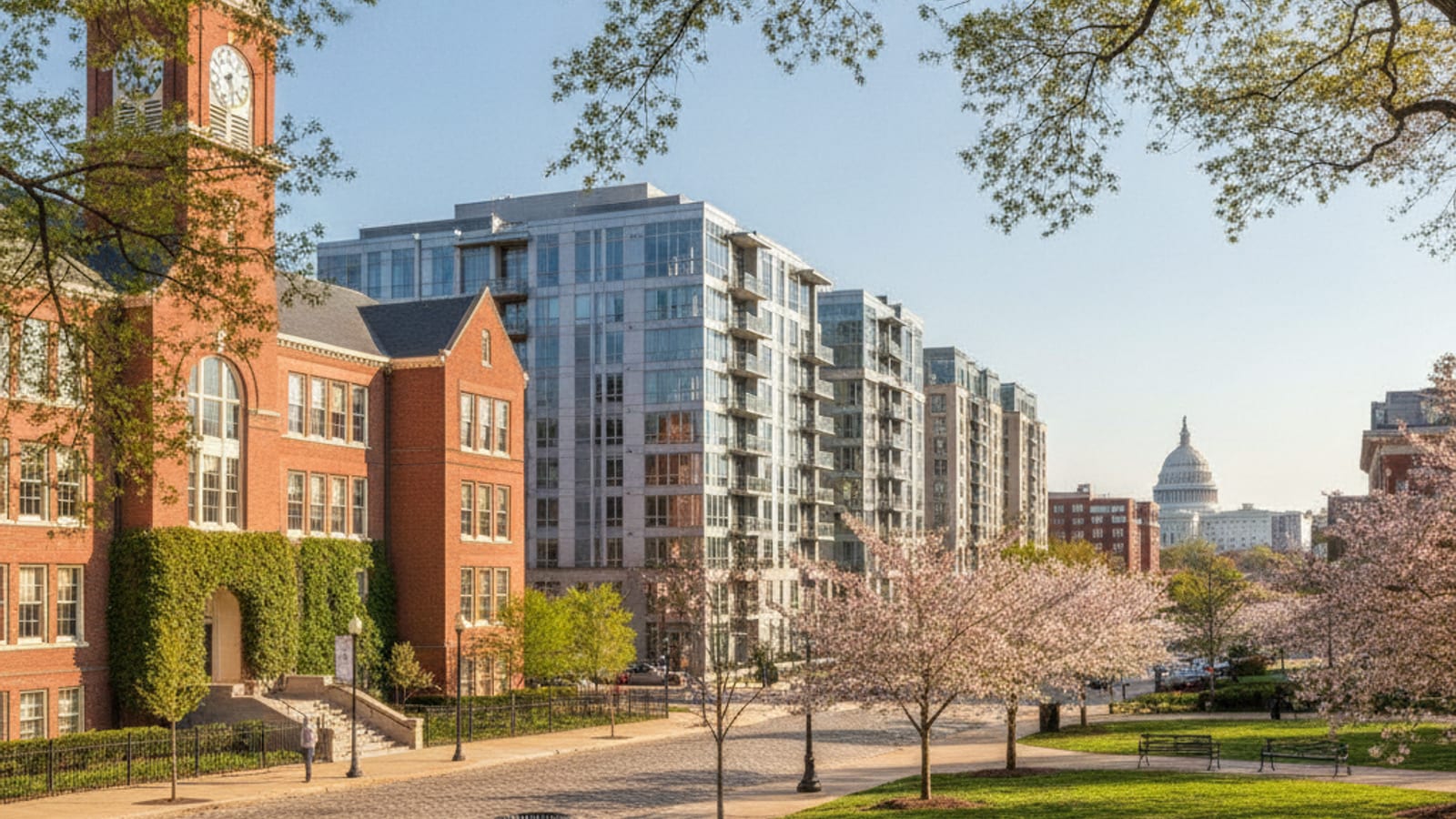
One of the first things to check before making an offer on a Washington, DC home is simple but critical: which DCPS address school zone does this property fall in? DC Public Schools assigns every residential address to a specific elementary, middle, and high school based on geography — and those boundaries can shift from one block to the next. Understanding how the DCPS address and boundary system works is essential to making a confident purchase decision. This guide gives you a clear, step-by-step framework for verifying the assigned schools for a specific address before you make an offer, and for tracking what can change, so you never buy a home assuming a school assignment that isn't there.
How Does the DCPS Address and School Zone System Work?
DC Public Schools operates on an in-boundary (or "in-bounds") enrollment model. Every DC residential address is assigned to one elementary, one middle, and one high school based on a set of official geographic boundaries. Students in grades K–12 who live at an in-boundary address have a guaranteed right to enroll at that school — a meaningful advantage in a city where some schools can have long out-of-bounds waitlists.
To look up which schools are tied to a specific address, use the School Finder on the My School DC website, myschooldc.org. Enter a DC address and it shows the DCPS in-boundary schools for that location. DCPS runs its own "Find Your In-Boundary School" lookup at enrolldcps.dc.gov. Boundaries do change, so recheck before closing.
For a visual check, DC's open data portal (opendata.dc.gov) publishes school boundary maps: DCPS attendance-zone layers published through DC GIS for the Office of the Chief Technology Officer. They show the street-by-street lines that define each zone — useful when you're deciding between two houses on the same block — but rely on the lookups above for the assignment.
Why Your DCPS Address Matters More Than the Zip Code
Zip codes are notoriously misleading when it comes to school assignments in DC. A 20016 address in Spring Valley might feed into one set of schools, while a property three streets away with the same zip code falls into a completely different boundary. The same dynamic plays out across Ward 3, Capitol Hill, Brookland, and Petworth.
School assignment in DC does not work the same way as in Fairfax or Arlington counties, where large feeder zones are relatively stable. DC's system is more granular and more politically charged — boundaries have been redrawn multiple times over the past decade, and proposals for future changes surface regularly. Before you write an offer, confirm the current in-boundary assignment directly through DCPS, and ask your agent whether any boundary review process is underway in that neighborhood.
For the full picture, our dedicated Washington, DC schools guide covers the zoned high schools and their feeder patterns, where the boundary lines fall, the lottery, and recent and pending boundary changes.
Step-by-Step: How to Look Up a DCPS Address
- Go to myschooldc.org and open the School Finder — or use DCPS's in-boundary lookup at enrolldcps.dc.gov.
- Enter the full street address of the property you're evaluating.
- Review the in-boundary schools at the elementary, middle, and high school levels. Note the school names and check each one on OSSE's DC School Report Card.
- Check application deadlines for out-of-boundary lottery schools — the My School DC application opens in mid-December (December 15, 2025 for 2026–27); 2027–28 deadlines are February 1, 2027 for grades 9–12 and March 1, 2027 for PK3–grade 8.
- Look at the DC GIS map (opendata.dc.gov) for a visual sense of where the zone edges fall, then confirm the assignment in the School Finder or DCPS's lookup, especially if the address sits near an edge.
- Ask your agent to note the in-boundary school assignment in writing as part of your due-diligence checklist.
DC's Lottery System: An Alternative to Public School In-Boundary Seats
Whatever a home's in-boundary assignment, DC's citywide lottery is one of the most expansive school-choice systems in the country. Through My School DC, applicants can rank up to 12 schools — including DC Public Schools campuses, DC Public Charter Schools, and application high schools like School Without Walls or Banneker — and results come out in the spring (March 27, 2026 for 2026–27).
Charter schools in DC do not use address-based boundaries at all; any DC resident can apply regardless of where they live. This is an important distinction for buyers: a home's address sets its in-boundary DCPS schools but has no bearing on charter school applications.
Private and independent schools are another route in DC. Georgetown Day School, Sidwell Friends, and St. Albans draw students from across the metro. Published 2026–27 tuition at Sidwell Friends runs from $55,250 (preK–2) to $62,330 (Upper School), and St. Albans lists $59,938 for day students.
DC Metro Prices and Inventory in 2026
According to Realtor.com via FRED, the DC metro's overall inventory has been rising — Arlington County, VA, for example, saw active listings climb 17.8% year-over-year as of August 2026, giving buyers in that market more leverage.
The DC metro's median sold price reached $635,000 in March 2026, up 1.6% year-over-year, according to Bright MLS's March 2026 market report for the DC metro.
If you're also weighing a move to a Northern Virginia suburb where school boundaries and tax implications differ substantially, the Fairfax Property Tax: 2026 Complete Guide is a useful companion for understanding carrying costs across jurisdictions. And if you're considering a smaller home outside DC proper, our guide to downsizing in Alexandria, VA covers walkable alternatives just across the river.
What Buyers Should Confirm Before Closing
School boundary assignments are not automatically disclosed in DC sales contracts the way square footage or HOA fees are. That puts the verification burden squarely on the buyer. Here's a short checklist to run before you remove contingencies:
- Confirm the in-boundary school assignment directly in the School Finder or DCPS's lookup using the exact property address — not the neighborhood name or zip code.
- Check the DCPS website for any pending boundary amendment proposals that could affect the zone.
- A school-boundary contingency can be written into an offer; your agent can advise on local practice.
- Compare the My School DC application dates with your anticipated closing and move-in date.
Our Washington, DC homes for sale page is the most direct starting point to browse DC inventory by neighborhood — which you can then cross-reference with the DCPS address lookup tool to confirm each property's assigned schools.
The Bottom Line on DCPS Boundaries
In DC, school assignment follows the exact address, not the neighborhood or zip code. A five-minute School Finder lookup can confirm a property's school assignment — or reveal that the school you expected is two blocks and one boundary line away. Work with an agent who knows DC's boundary geography intimately, and verify every address individually.