
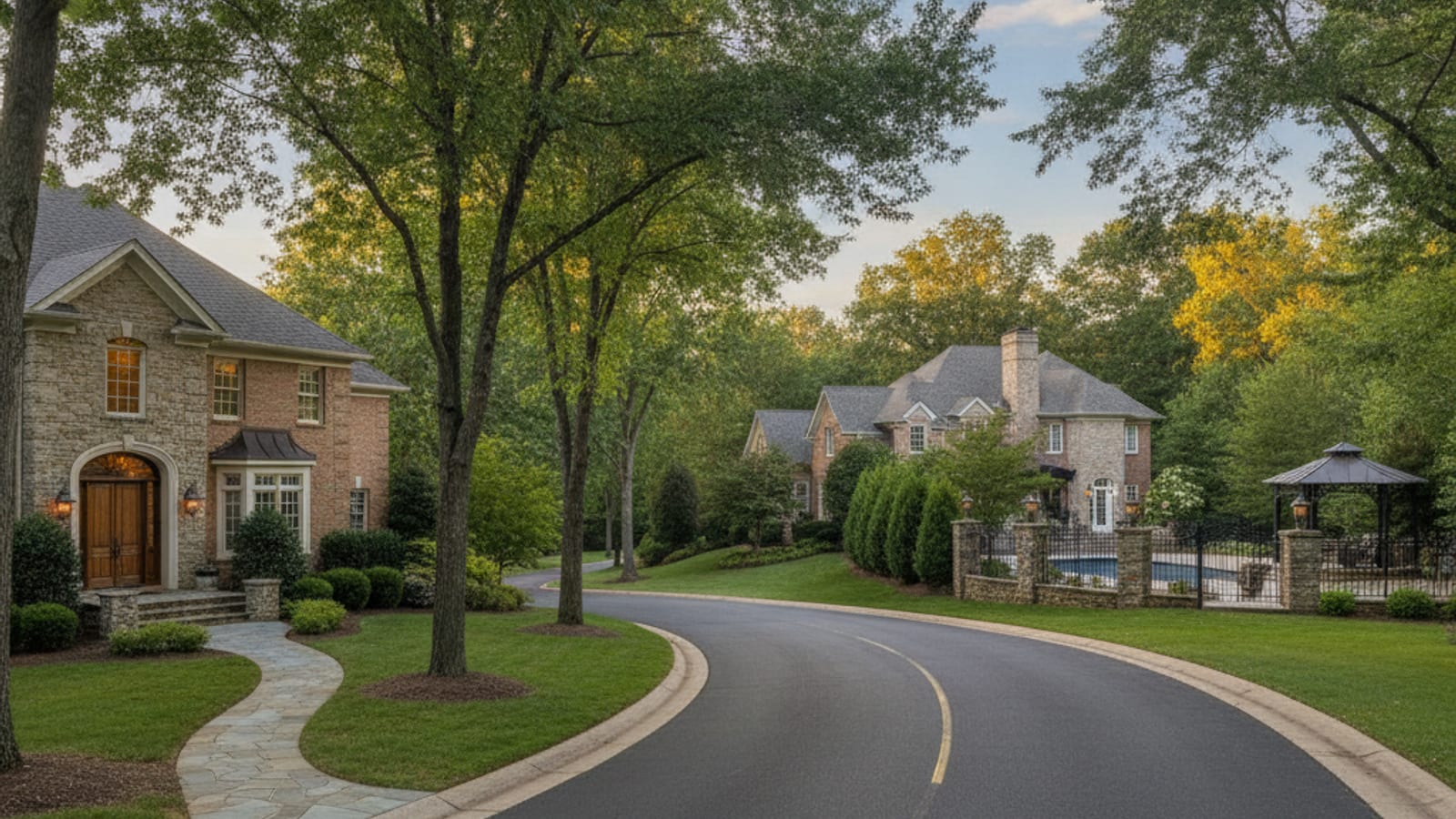
Great Falls, Virginia is one of the most coveted addresses in the Washington, DC metro — and for good reason. Acres of hardwood forest, Potomac River views, and a commute that still reaches Tysons or downtown DC in under 40 minutes make it singular. But "Great Falls" is not one neighborhood; it is a mosaic of distinct pockets, each with its own character, lot profile, and price tier. If you are weighing a move here, understanding those differences before you start touring homes will save you months of misdirected searching. This Great Falls VA neighborhoods guide breaks down the key areas, their homes and lot sizes, and the market realities every serious buyer should know.
Why Great Falls Stands Apart in Fairfax County
Great Falls sits in the northwest corner of Fairfax County, bounded by the Potomac River to the north and east, with McLean to the southeast. The entire community is zoned to preserve large-lot living — most parcels run one to five acres — which is extraordinarily rare this close to a major capital city. Fairfax County's median listing price stood at $767,000 in July 2026, per Realtor.com via FRED, but Great Falls routinely trades well above that floor; entry-level single-family homes here typically start above $1 million, and estate properties regularly reach $4 million to $8 million.
Homes also move quickly: Fairfax County's median days on market was just 31 days as of July 2026 — unchanged year-over-year — signaling that well-priced Great Falls listings attract immediate, serious attention. Before you fall in love with a specific street, understand that the competition is real and preparation matters. Our guide to winning without contingencies in the luxury market outlines exactly how buyers can stay competitive at these price points.
Great Falls VA Neighborhoods Guide: Key Pockets to Know
Great Falls does not have named neighborhoods with the rigid boundaries you would find in a city. Instead, buyers and agents refer to a set of well-understood pockets — some formal subdivisions, some informal geographic clusters — each carrying a distinct identity.
The Estate Core: Springvale Road and River Bend Road Corridors
The gold standard of Great Falls living hugs the Potomac bluffs along River Bend Road and fans out along Springvale Road. Properties here routinely exceed two to five acres, and many back directly onto protected parkland along the Potomac. Custom-built colonial, transitional, and contemporary estates dominate — think seven-figure renovation budgets, geothermal systems, and home theaters. This pocket offers maximum land and privacy. The trade-off is distance from Route 7 retail, so day-to-day errands require a car. If you are drawn to natural surroundings and want to explore what makes this area so distinctive beyond its real estate, our piece on hidden gems in Great Falls, VA uncovers the local trails, viewpoints, and community spots that define everyday life here.
Around Colvin Run Mill: The One- to Two-Acre Sweet Spot
Between the village center and the Colvin Run Mill Historic Site, lots in the subdivisions here tend to run one to two acres, homes lean toward traditional brick colonials built between the late 1970s and mid-2000s, and price points are comparatively accessible for Great Falls, often in the $1.1 million to $2.2 million range.
Much of the area is assigned to the Langley High School pyramid; confirm the assignment for any specific address with the Fairfax County Public Schools boundary locator. Active listings across Fairfax County climbed 15.1% year-over-year by July 2026, per Realtor.com via FRED, giving buyers in this price band a little more breathing room than the frenzied 2022–2023 era — though well-presented homes still move fast.
Seneca Ridge and Great Falls Chase: Newer Construction, Less Maintenance
The area's smaller planned subdivisions from the 1980s and 1990s offer the Great Falls address without the upkeep burden of a century-old farmhouse or a sprawling custom estate. Lots are smaller — typically half an acre to one acre — but homes are generously sized (4,000–6,000 square feet), well laid out for modern living, and easier to maintain. HOA structures keep common areas manicured.
Value in these planned communities is also more consistently comparable than in the custom-estate pockets.
Walker Road and the Village Center Perimeter
The area immediately surrounding the Great Falls Village Centre — a low-key cluster of restaurants, boutiques, and professional offices around the village green on Walker Road — offers a different lifestyle proposition. Some lots here are smaller, and a handful of older, more modest homes exist alongside newer infill construction. The appeal is walkability by Great Falls standards: you can reach coffee, a wine shop, or a yoga studio without driving. This zone is also the entry point for buyers stretching into Great Falls from the $900,000–$1.2 million range.
Equestrian Estates: The Rx Hill and Georgetown Pike Acreage
Along Georgetown Pike and the rural roads branching north from it, Great Falls transitions into genuine horse country. Four-to-ten-acre parcels with run-in sheds, riding rings, and board fencing are not unusual. Parcels here support horse-keeping and maximum separation from neighbors, and some can qualify for agricultural exemptions on property taxes. Prices vary enormously based on improvements — a restored farmhouse on seven acres can fetch as much as a newer estate in the Springvale corridor. Zoning here is among the most protective in all of Fairfax County, which is precisely the point. Browse current Great Falls, VA homes for sale to see what is active across all of these pockets right now.
How to Choose the Right Great Falls Pocket for You
Every buyer comes to Great Falls with a different priority stack. Here is a practical framework:
- Maximum land and privacy: Focus on the River Bend Road and Springvale corridors. Budget $2.5 million and up; have financing fully arranged before you tour.
- One to two acres, lower price point: the subdivisions around Colvin Run Mill offer brick colonials from the late 1970s to mid-2000s. Budget $1.1M–$2.2M.
- Newer construction, easier maintenance: the 1980s–90s planned subdivisions offer the lifestyle with fewer surprises. Budget $1.3M–$2.5M.
- Walkable village access: The blocks around the Village Centre put coffee, restaurants, and boutiques within walking distance. Budget $950K–$1.6M.
- Equestrian or agricultural lifestyle: Georgetown Pike acreage is unmatched. Budget is wide-ranging; zoning research is essential before any offer.
What Great Falls VA Buyers Should Know Before Making an Offer
Several practical realities shape the Great Falls buying experience. First, well water and septic systems are the norm across most of the community — buyers accustomed to municipal utilities should budget for inspection specialists and understand ongoing maintenance responsibilities. Second, the absence of a Metro stop means car dependency is non-negotiable; proximity to the Dulles Toll Road or Georgetown Pike determines commute quality more than any other single variable.
Third, Fairfax County real estate taxes apply, and at the price points typical of Great Falls, annual tax bills are substantial — worth modeling carefully into your holding costs before you bid. If you are also weighing how Great Falls compares to other Fairfax County communities nearby, the Hollin Hall Wellington neighborhood guide offers a useful side-by-side perspective on large-lot living in Northern Virginia. For a broader picture of what the Great Falls lifestyle entails day-to-day before you commit, the Great Falls VA relocation guide covers everything from commute realities to lot sizes and utilities in detail.
The Bottom Line on Great Falls Neighborhoods
Great Falls, VA rewards buyers who do their homework. The community's finest quality — its preserved, low-density character — also means that each pocket operates almost like its own micro-market, with distinct lot sizes, architectural styles, school bus routes, and price ceilings. The winning approach is to narrow your search to the right pocket first, then pursue listings with conviction. Given Fairfax County's 31-day median days on market, hesitation is costly. Work with an advisor who understands these distinctions at the street level, and you will make a far more confident — and lasting — decision.