
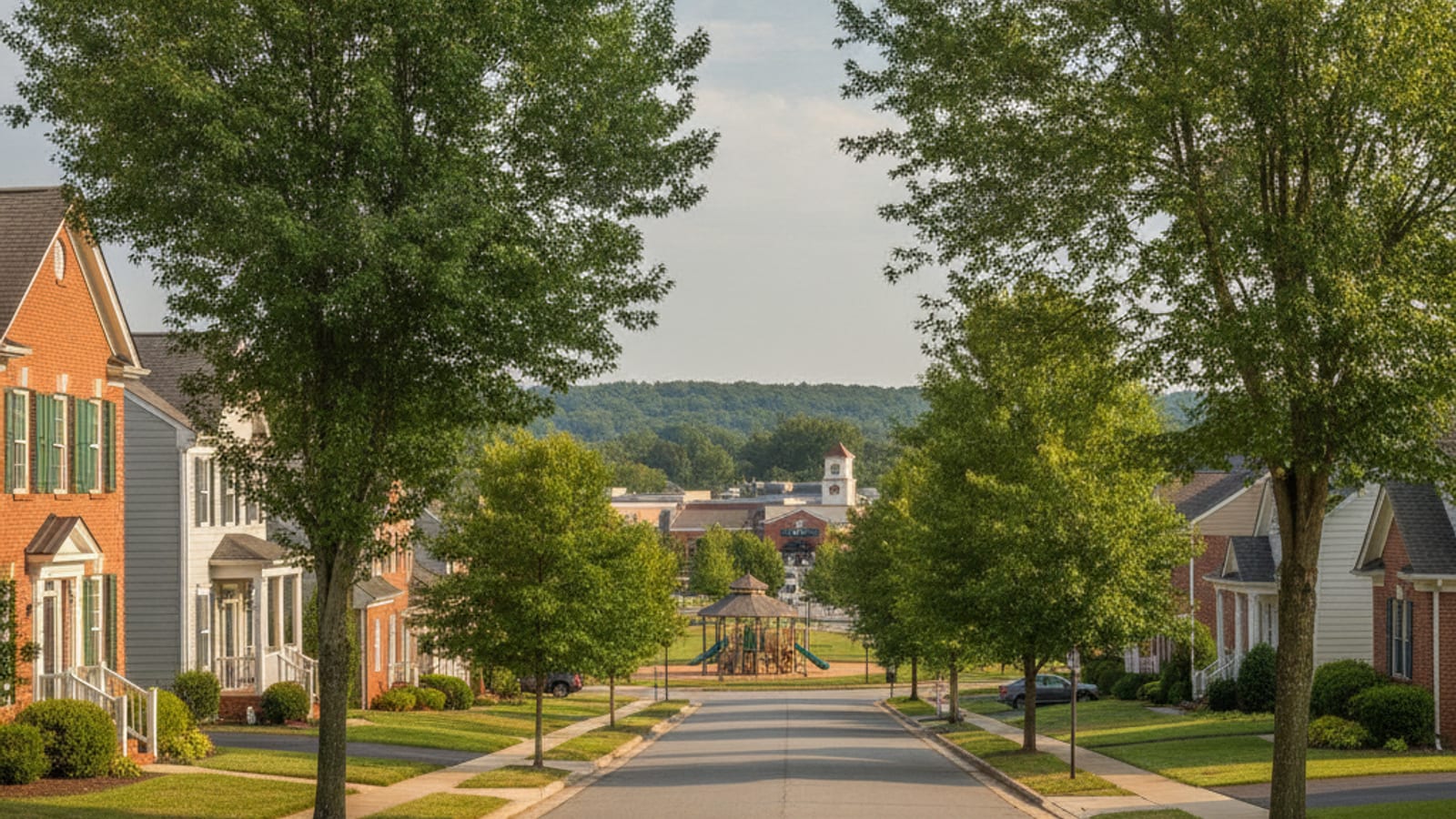
Moving to Fair Oaks is a decision that puts you squarely at one of Northern Virginia's great transportation crossroads — the junction of I-66, U.S. Route 50 (Lee-Jackson Memorial Highway), and the Fairfax County Parkway, with Fair Oaks Mall anchoring the community's commercial heart. It is an unincorporated community in Fairfax County, sitting just west of the City of Fairfax, with a mix of townhouse subdivisions, single-family neighborhoods, and condominium communities built primarily between the late 1970s and the early 2000s.
The fundamentals are genuinely appealing: established tree-lined streets, strong highway access, and a range of price points within a county whose median listing price stood at $709,900 in October 2026, according to Realtor.com via FRED. If you are seriously considering buying here, the checklist below is what you need to work through before you make an offer.
What Kinds of Homes Are in Fair Oaks?
Fair Oaks is not a single subdivision — it is a collection of distinct neighborhoods that developed in overlapping waves. The oldest sections, built in the late 1970s and early 1980s, include two-story colonial and split-level townhouses clustered near Route 50 and the nascent Parkway corridor. Through the mid-1980s to mid-1990s, larger single-family subdivisions filled out the area with four-bedroom center-hall colonials, many on quarter-acre to half-acre lots with two-car garages. Condominium communities — both garden-style and stacked flat buildings — round out the inventory, offering smaller square footages and lower entry price points than the detached market.
Lot sizes in the single-family sections vary considerably; some back to community open space or the edges of Fairfax County's park land, which affects both privacy and resale appeal. When reviewing a specific address, confirm the year built, any additions permitted after original construction, and whether the lot contains any easements — utility or stormwater — that reduce usable yard space. Browse current listings in Fair Oaks and the surrounding Fairfax County communities to see what is actively available across all three housing types.
Parks, Trails, and Open Space Near Fair Oaks
Ox Hill Battlefield Park, located on Ox Road in the Fair Oaks area, is one of the community's most historically significant green spaces — a small but dignified Fairfax County park commemorating the Civil War Battle of Chantilly fought in September 1862. It includes a monument and interpretive markers and is managed by Fairfax County Park Authority.
Beyond Ox Hill, the Fairfax County Parkway trail network runs alongside the Parkway itself, providing a paved multi-use path that connects Fair Oaks northward and southward through Fairfax County's trail system. Buyers who place value on walkable or bikeable green space should confirm which specific trail segments are accessible from a given address — not every street in Fair Oaks has the same proximity to the Parkway trail, and some sections require crossing high-traffic roads to reach a trailhead.
How Do You Get Around From Fair Oaks?
The community's location at the I-66, Route 50, and Fairfax County Parkway junction is its defining transportation feature. I-66 provides direct access into Arlington and Washington, DC to the east, and toward Gainesville and the Shenandoah Valley to the west. Route 50 runs parallel to I-66 and offers a surface-road alternative that passes through the City of Fairfax, Annandale, and Arlington before reaching DC. The Fairfax County Parkway connects to the Springfield/Franconia interchange of I-95 to the south and to Route 7 and the Dulles Toll Road corridor to the north.
For transit riders, Fairfax Connector bus service operates routes in and around the Fair Oaks area, linking the community to the broader bus network. The Dulles Corridor Metrorail Project's Silver Line provides additional options at stations to the north along the Dulles corridor, though these require highway access from Fair Oaks. Fairfax County also participates in several commuter bus programs for express service toward downtown Washington.

What Should You Check Before Buying in Fair Oaks?
Because Fair Oaks is an unincorporated community, it has no town hall, no town council, and no municipal services of its own. Every permit, zoning inquiry, code enforcement matter, stormwater question, and public service is handled by Fairfax County directly. That means your contractor pulls permits through Fairfax County's Department of Land Development Services, your zoning questions go to the Fairfax County Department of Planning and Development, and any dispute about an unpermitted addition on the property you are buying is resolved at the county level. Confirm the permit history of any home you are seriously considering — Fairfax County maintains online records, and your agent can help you identify additions or finished basements that may have been completed without required permits.
HOA and Condominium Association Resale Documents
The vast majority of Fair Oaks homes — townhouses, single-family homes in platted subdivisions, and all condominium units — are governed by a homeowners association or condominium owners association. Under the Virginia Property Owners' Association Act and the Virginia Condominium Act, the seller is required to deliver a resale disclosure package before closing. For an HOA, this includes the current declaration, bylaws, rules and regulations, the most recent reserve study or reserve fund disclosure, the current budget, and a statement of any outstanding assessments or violations on the property.
For a condominium, the package is similarly comprehensive and includes the association's financial statements. Virginia law gives you a specific rescission period after receipt of the complete package — do not waive or abbreviate your review of these documents. Pay close attention to the reserve fund balance relative to anticipated capital expenditures: roof replacements, parking lot resurfacing, and pool or amenity repairs in communities built in the 1980s and 1990s are frequently the subject of special assessments when reserves are underfunded.
Noise, Traffic, and Environmental Considerations
Living near I-66, Route 50, and the Fairfax County Parkway means that traffic noise is a real variable — one that differs dramatically between a home backing to a wooded buffer and one fronting a collector road feeding the interchange. When you tour a property, visit at different times of day: rush-hour noise levels on I-66 and Route 50 near Fair Oaks can be substantially higher than a midday visit suggests.
For properties near low-lying areas along any of the stream corridors that drain toward the Occoquan watershed, check the current Fairfax County floodplain maps maintained by the county's Stormwater Planning Division. FEMA's Flood Map Service Center is the federal reference, but Fairfax County's own maps and floodplain administrator are the operative local contacts. A property in or near a Special Flood Hazard Area will require flood insurance, which is a carrying cost you need to account for before — not after — closing.
Carrying Costs and the Tax Picture
Fairfax County's real property tax, stormwater fee, solid waste fee, and any applicable special district levies combine to create a carrying cost that can vary meaningfully from one address to another even within Fair Oaks. The county also conducts annual real property assessments, so your tax burden can shift year to year independent of whether you make any improvements.
For a full breakdown of how these costs are structured and what buyers and sellers typically pay, see the Fairfax County real estate tax guide, which covers every component without requiring you to calculate your own estimate from raw rates. If you believe a future assessment is out of line with market value, Fairfax County provides a formal appeal process — a separate topic covered in detail for property owners who want to understand their options after they buy.
What Does the Fairfax County Market Look Like Right Now?
Fair Oaks sits within Fairfax County's broader market, and the county-wide indicators give useful context for any offer you are preparing. By the week ending November 1, 2026, active county inventory had risen to 2,088 listings, up from 1,539 in the same week a year prior, and the median days to contract had extended to 37 days. That inventory growth is meaningful for buyers: more choice and slightly more time to conduct diligence.
The county-wide median listing price was $709,900 in October 2026 per Realtor.com via FRED, down 9 percent year-over-year, while active listings across Fairfax County reached 2,479 — up 32.1 percent compared to October 2025. These are county-wide figures covering every price range; conditions within any specific Fair Oaks neighborhood or property type will vary. Understanding what features are driving buyer interest in Fairfax County right now can also sharpen your search criteria — the top home features Fairfax County buyers want most is worth reviewing before you finalize your must-have list.
The Due-Diligence Checklist Before You Close When Moving to Fair Oaks
- Permit history: Pull the Fairfax County permit record for the property and confirm all additions, finished spaces, and mechanical upgrades were permitted and closed out.
- HOA or condo resale package: Request it immediately upon ratification; read the reserve study, budget, and any pending litigation disclosures before your rescission period expires.
- Floodplain status: Check the Fairfax County floodplain map for the specific parcel, not just the general neighborhood — stream buffers and low-lying lots can carry flood risk that is not obvious from a street view.
- Noise assessment: Tour the property during peak I-66 and Route 50 commute hours and, if the home backs to a wooded area, confirm the buffer is on park or HOA land rather than a privately owned parcel that could be developed.
- Carrying costs: Request the most recent real property tax bill, HOA assessment schedule, and any special assessment notices so you can build an accurate monthly cost picture before you are under contract.
- Title search: Confirm there are no outstanding liens, easements of record that restrict use, or boundary disputes — especially relevant on lots adjacent to county park land or utility corridors.
- Home inspection scope: In homes built in the 1980s and early 1990s, specifically request inspection of HVAC systems, roofing, and any original plumbing, as these components are at or near the end of their typical service life.
Moving to Fair Oaks puts a broad range of Fairfax County housing within reach, from entry-level condominiums to spacious single-family colonials, all within one of Northern Virginia's most connected highway corridors. The due-diligence steps above are not obstacles — they are the information that lets you buy with confidence. If you are comparing Fair Oaks to other Fairfax County or Northern Virginia communities, the buyer preference data for Fairfax and a conversation with a local agent who knows the county's permit and assessment systems will serve you well before you make your move.
Based on information from Bright MLS for September 1, 2026 through September 30, 2026; data is reliable but not guaranteed.
Based on information from Bright MLS for October 26, 2026 through November 1, 2026; data is reliable but not guaranteed.