An entire county across the Potomac from Washington — where Rosslyn–Ballston, Columbia Pike, National Landing and the older North Arlington streets behave like four different markets.
Arlington is an urban county directly across the Potomac from Washington, DC — roughly 26 square miles with no incorporated towns inside it, so within the county line there is only one local government to deal with. Searching it as one market is the usual mistake. Arlington works as four markets: the Rosslyn–Ballston corridor built around five Metro stations, Columbia Pike under its own form-based code, National Landing at Crystal City and Pentagon City, and the older North Arlington streets platted as trolley suburbs a century ago. High-rise condos in Rosslyn and Ballston, 1920s bungalows, 1940s garden apartments long since sold as condominiums, and postwar brick ramblers all trade here, often within a mile of one another.
Arlington is a county, not a neighborhood and not a city — roughly 26 square miles in all, about 25.8 square miles of it land, and commonly described as the smallest self-governing county in the United States by area. The 2020 census counted 238,643 residents. It contains no incorporated towns or cities: Virginia law bars a court from ordering a new town into existence where the surrounding county's density exceeds 200 people per square mile (Va. Code § 15.2-3602), so Arlington is a single jurisdiction with dozens of informally named neighborhoods, one set of county taxes, and one school division. The land was part of the original District of Columbia until the Virginia portion was retroceded — Congress approved retrocession in 1846 and Virginia's acceptance took effect in 1847 — and it carried the name Alexandria County until 1920, when it was renamed for the Arlington estate. Arlington voters adopted the county manager plan in 1930 and elected the first five-member at-large County Board in 1931; as of August 2026 that is still the structure, a five-member at-large Board that appoints a county manager. The county also bills water and sewer directly: it distributes drinking water it buys wholesale from the Army Corps of Engineers' Washington Aqueduct, and it treats its own wastewater. Arlington Public Schools assigns every county address to a neighborhood elementary, middle and high school — as of August 2026 the three comprehensive high schools are Washington-Liberty, Yorktown and Wakefield — and because attendance boundaries are periodically redrawn, confirm the current assignment for a specific address with APS rather than relying on a listing.
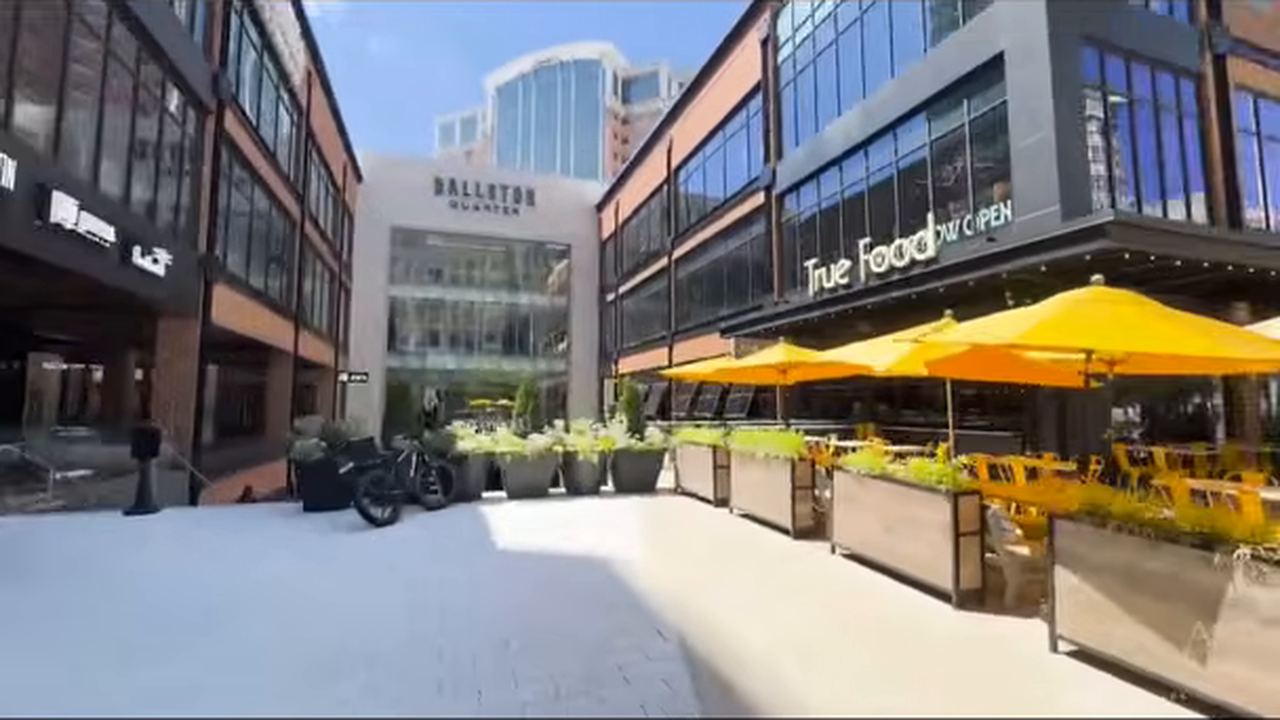
This corridor exists because of a decision made in the 1960s. Arlington adopted its first General Land Use Plan in 1961, and when Metro was being routed, county officials — County Manager Bert Johnson and transportation director Clifton "Stoney" Stoneburner among them — pushed to tunnel the Orange Line under Wilson Boulevard through the aging commercial strip instead of running it in the I-66 median as a commuter line. The 1975 plan update removed many planned highways and fixed the station locations. Rosslyn opened July 1, 1977; Court House, Clarendon, Virginia Square–GMU and Ballston–MU all opened December 1, 1979. The Silver Line shares all five, and Rosslyn also carries the Blue Line. East Falls Church, at the corridor's western end, opened on the Orange Line on June 7, 1986, and the Silver Line has served it as well since 2014. Density was then concentrated in tapering "bull's-eyes" around each station, which is why a 30-story tower and a 1920s bungalow can sit a few hundred feet apart and why walking distance to a platform changes block by block rather than neighborhood by neighborhood. Central Place at Rosslyn, at 391 feet, was completed in 2017 and remained the tallest building in the county as of August 2026; its top-floor public observation deck closed in 2024, when CoStar Group took the space for its headquarters. Ballston Quarter replaced the enclosed Ballston Common Mall, its retail reopening in November 2018 beneath a new 406-unit apartment tower.
The older single-family neighborhoods read as a timeline of how people got to Washington. Maywood, platted in five sections between 1909 and 1913, is among the county's best-preserved trolley-era subdivisions, with bungalows, gable-front farmhouses, American Foursquares and early revival styles. Cherrydale grew up around the Great Falls & Old Dominion Railroad in the early 1900s. In 1919 developer Frank Lyon divided a 300-acre tract into roughly 1,200 lots to create Lyon Park, whose houses range from 1920s Craftsman bungalows to Colonial Revival of the 1930s and 1940s. Westover, established in 1940, mixes Colonial, Craftsman and Cape Cod houses with two-story garden apartments, townhouses and duplexes. Then came the postwar wave: Arlington Forest and Bluemont are largely 1940s and 1950s Cape Cods and frame colonials, with brick ramblers and split-levels filling in through the 1960s. Almost none of this stock was built to the footprints buyers now expect, so the questions that matter on tour are which systems have actually been replaced, whether a finished basement was permitted, and whether a rear addition or a pop-top is even possible under Arlington's lot-coverage limits. Those limits vary by district across R-5 through R-20 and cap the main building separately from total coverage, so run the specific district against the current zoning ordinance before you price the work. Two regional trails also edge these neighborhoods: the W&OD Trail begins at mile zero at Four Mile Run near Shirlington and runs 45 miles west to Purcellville, and the Mount Vernon Trail follows the Potomac along the county's eastern edge.
Columbia Pike runs roughly three and a half miles across Arlington from the Fairfax County line to the Pentagon. It carried the Route 244 designation for decades, but Arlington took over most of its length from the state in 2010, and as of August 2026 only a short stretch near the Pentagon interchange is still a state primary route. The single most important fact about the Pike is that it has no Metro station. Arlington's answer was zoning rather than rail: the County Board adopted a Commercial Centers Form Based Code in 2003 for the Pike's commercial nodes, and after the 2012 Columbia Pike Neighborhoods Area Plan it adopted a Neighborhoods Form Based Code on November 16, 2013 covering the multifamily areas around them. Form-based zoning regulates building form, frontage and height rather than use, and it lets qualifying projects proceed administratively instead of through Arlington's negotiated site-plan process — which is why redevelopment along the Pike kept moving even after the transit plan collapsed. On November 18, 2014 the County Board voted 4–1 to cancel both the Columbia Pike streetcar and the Crystal City line, together estimated at more than half a billion dollars, leaving upgraded bus service in their place; as of August 2026 the county brands that service Pike Ride. The corridor and its surroundings also hold much of Arlington's garden-apartment stock. Fairlington, built 1942–44 by the Defense Homes Corporation, holds 3,439 apartments in 579 low-rise buildings on 322 acres and is described by the Virginia Department of Historic Resources as the largest apartment complex in the nation at the time; it was renovated and sold as condominiums between 1972 and 1977 and is listed on the National Register and the Virginia Landmarks Register. Fairlington also straddles a jurisdictional line: most of it lies in Arlington County and a portion falls inside the City of Alexandria, so taxes, schools and local government all depend on which side of the line an address falls on. Colonial Village near Rosslyn, begun in 1935 by developer Gustave Ring, was the first large-scale rental housing project in the country insured by the Federal Housing Administration.
National Landing is the name adopted for Crystal City and Pentagon City in Arlington together with Potomac Yard across the line in Alexandria. Crystal City was built largely in the 1960s and 1970s by the Charles E. Smith companies on former industrial land; the Crystal City Underground concourse opened in September 1976 and, as of August 2026, still links much of the district below grade. Amazon's HQ2 landed here. Metropolitan Park — two 22-story towers named Jasper and Merlin with 2.1 million square feet — opened June 15, 2023. The second phase, PenPlace — three 22-story office buildings plus the 350-foot spiral tower called the Helix — was paused when Amazon halted construction in March 2023; the County Board extended the site plan's term of validity in June 2025 to June 30, 2028, and reporting in April 2026 found construction still paused and HQ2 headcount roughly flat. The transportation projects around it are at very different stages. Metro is building a second, east entrance to Crystal City station near 18th Street S and Crystal Drive; the weekend closures it required ran from February into June 2026 and wrapped ahead of schedule, and as of August 2026 WMATA expected the entrance to open in summer 2027. VRE's Crystal City station, a single short side platform as of August 2026, is slated to be rebuilt with an 850-foot island platform serving two tracks — a low-level section for VRE and a high-level section for Amtrak — on a schedule that has moved more than once, so confirm the current one with VRE before you rely on it. As of August 2026, the Long Bridge Project was adding new rail bridges plus a bicycle and pedestrian span across the Potomac. VDOT's Connecting National Landing proposal would bring the elevated Route 1 freeway between 12th and 20th Streets S down to an at-grade boulevard, but as of August 2026 VDOT's project page listed start date, completion date and cost as to be determined, with roughly $97 million in federal funding not yet secured. Ronald Reagan Washington National Airport sits inside the county with its own Metro station on the Blue and Yellow lines. Housing is mostly 1960s and 1970s high-rises plus newer towers, and vacant offices have been converted under a county adaptive-reuse program — a pair of 11-story 1968 buildings at 2100 and 2200 Crystal Drive was approved in December 2024 to become a 330-key hotel and roughly 200 residences.
Based on information from Bright MLS for September 1, 2026 through September 30, 2026; data is reliable but not guaranteed.
This is the zoning question that determines what can legally be built on an Arlington house lot, and as of August 2026 it remained genuinely unresolved. On March 22, 2023 the County Board unanimously adopted Expanded Housing Options, effective July 1, 2023, allowing two- to six-unit buildings by right on lots in the R-5, R-6, R-8, R-10 and R-20 districts that had been limited to detached houses. An EHO building must fit the same maximum height, footprint and minimum setbacks already allowed for a detached house, with overall size capped from roughly 4,800 square feet for a duplex to 8,000 square feet for a five- or six-unit multiplex, and parking of at least 0.5 space per unit within three-quarters of a mile of Metrorail (or half a mile of other transit) and one space per unit elsewhere. The ordinance also capped permits at 58 per year for five years from July 2023 and allocated 9 percent to R-5, 66 percent to R-6 and the remaining 25 percent across R-8, R-10 and R-20 — roughly five, thirty-eight and fifteen permits respectively. The litigation followed, and its path matters more than its headlines. On September 27, 2024, Arlington Circuit Court Judge David Schell ruled for the plaintiffs on four of six counts and declared the ordinance void. The county appealed, and on June 24, 2025 the Court of Appeals of Virginia reversed him on a procedural ground: builders already holding EHO permits should have been allowed into the case as necessary parties, so the circuit court's judgment could not stand. That put the ordinance back on the books without any court reaching the question of whether it is lawful. The same panel then granted the plaintiffs a rehearing on July 8, 2025 and withdrew its opinion, briefly voiding the ordinance again, before reinstating that opinion on September 5, 2025. It was the plaintiffs who went up from there: they petitioned the Supreme Court of Virginia in October 2025, the court agreed on May 19, 2026 to hear the case without halting EHO development in the meantime, and as of August 2026 no decision had issued. What is on appeal is the procedural question, not the merits — so a plaintiffs' win in Richmond would most likely send the case back down rather than settle whether the ordinance itself is valid. Permits have continued to issue throughout, with 59 EHO projects on the county's permitting dashboard as reported in spring 2026, though some have since reverted to single-family plans. If you are buying a lot for what could be built on it, or selling one and being told what it is worth to a builder, the posture of this case is not a footnote.
Arlington's local historic districts range from a single building to an entire neighborhood, and the distinction that costs owners money is between local designation and the National Register. A local historic district is enforceable: exterior changes require a Certificate of Appropriateness from the Historical Affairs and Landmark Review Board, though as of August 2026 many routine items in Maywood move through an administrative Certificate issued by preservation staff. Maywood, about 46 acres, became Arlington's first neighborhood local historic district in 1990. National Register listings on their own — Ashton Heights and Fairlington among them — are largely honorary and do not carry the same review. Environmental rules bind as well. Under the county's Chesapeake Bay Preservation Ordinance, Resource Protection Areas cover streams, wetlands and tidal shores plus a 100-foot vegetated buffer landward of them; the RPA map has been updated since its 2003 comprehensive revision, most recently in 2017, and as of August 2026 the county was bringing the ordinance in line with state amendments adding tree conservation and a resilience assessment — confirm the current map and ordinance text for a specific parcel. Arlington's tree preservation ordinance, its stormwater ordinance rewritten for the 2014 state regulations, and the Four Mile Run flood-control channel built with the Army Corps in the late 1970s and early 1980s all shape what can be done near a stream. Accessory dwellings are permitted — conversions of existing detached buildings since late 2017 and newly built detached units since May 2019 — subject to height and footprint limits that vary by district. County materials describe a detached accessory dwelling as limited to 25 feet and to 1.5 stories, with a footprint of no more than 560 square feet in R-5 and R-6 and no more than 650 square feet elsewhere; those figures were current as of August 2026, but verify them against the ordinance for your district. Short-term rentals require an Accessory Homestay permit, and as of August 2026 the unit must be the host's own primary residence, whether the host owns or rents it. And on any condominium or association-governed purchase, Virginia's Resale Disclosure Act gives you at least three days after the resale certificate is delivered to cancel — and longer if the ratified contract provides for longer, as of August 2026. The three days are a floor, not a default that a contract can shorten. Use that window on the reserve study, any pending special assessment, and the rental and parking rules.
 Buying
Downsizing in Alexandria, VA and wondering where to move? Explore the best nearby neighborhoods and suburbs for a smaller home.
 Communities
Bright MLS's August 2026 figures by jurisdiction, and what each of 16 areas around Washington offers by home type, lot and setting.
 Market Update
The 2026 DC metro luxury market is rewarding the well-prepared — here's what buyers and sellers in McLean, Bethesda, and beyond need to know right now.
Browse current listings, or reach Artur directly for private and off-market opportunities.
It is a county — roughly 26 square miles directly across the Potomac from Washington, DC, with no incorporated towns or cities inside it, so the county government handles taxes, zoning, schools, police, and your water and sewer bill. It was part of the original District of Columbia until the Virginia portion was retroceded — Congress approved retrocession in 1846 and Virginia's acceptance took effect in 1847 — and it was called Alexandria County until it was renamed in 1920. The place names people use — Clarendon, Ballston, Cherrydale, Shirlington — are neighborhoods, not separate jurisdictions.
Four broad kinds, and they rarely compete with one another. High-rise and mid-rise condominiums cluster along the Rosslyn–Ballston corridor and in Crystal City and Pentagon City. Garden-apartment condominiums, most famously Fairlington's 1942–44 buildings converted between 1972 and 1977, sit in south Arlington — though part of Fairlington falls across the line in the City of Alexandria, so check the jurisdiction of a specific address. Older single-family houses run from 1900s and 1920s bungalows and Foursquares in Maywood, Cherrydale and Lyon Park to 1940s Cape Cods and 1950s and 1960s brick ramblers and split-levels in Arlington Forest, Bluemont and Westover. And newer duplexes, townhouses and small multiplexes have appeared on former single-family lots under the county's Expanded Housing Options rules.
Expanded Housing Options, adopted March 22, 2023 and effective July 1, 2023, allows two- to six-unit buildings by right on R-5 through R-20 lots that previously allowed only detached houses, within the same height, setback and footprint envelope, and caps permits at 58 a year for the five years from July 2023. Arlington Circuit Court declared it void on September 27, 2024; the county appealed; the Court of Appeals of Virginia reversed that on June 24, 2025 on the procedural ground that builders holding EHO permits should have been parties, granted the challengers a rehearing on July 8, 2025, then reinstated its own ruling on September 5, 2025. The challengers took it up, and the Supreme Court of Virginia agreed on May 19, 2026 to hear the case without pausing EHO development; no decision had issued as of August 2026. Since only the procedural question is before that court, even a win for the challengers would probably return the case to the lower courts instead of resolving the ordinance's validity. The ordinance was in force and permits were still issuing as of August 2026, but confirm the current posture before you underwrite a lot on redevelopment value.
Eleven stations across four lines as of August 2026. The Orange and Silver lines run the Rosslyn–Ballston corridor — Rosslyn, Court House, Clarendon, Virginia Square–GMU, Ballston–MU, plus East Falls Church. The Blue and Yellow lines serve Pentagon, Pentagon City, Crystal City and Ronald Reagan Washington National Airport, with Rosslyn also on the Blue Line and Arlington Cemetery on the Blue Line alone. Most opened July 1, 1977 or December 1, 1979; East Falls Church opened June 7, 1986, on the Orange Line, and has been served by the Silver Line as well since 2014. Columbia Pike, by contrast, has no Metro station and is served by bus.
It depends on whether the district is local or national. In one of Arlington's local historic districts, exterior changes require a Certificate of Appropriateness from the Historical Affairs and Landmark Review Board, though as of August 2026 many routine items in Maywood go through an expedited administrative Certificate issued by county staff. A listing on the National Register alone does not impose that review. Separately, tree preservation, lot coverage caps and Chesapeake Bay Resource Protection Area buffers can limit what fits on a lot regardless of historic status — worth checking before you write an offer on a house you plan to expand.
Browse current Arlington listings below, or call Artur Guney at (703) 402-7500 for off-market options and for help comparing the corridors, since a Ballston condo, a Columbia Pike garden-apartment unit and a Cherrydale bungalow are effectively three different decisions.
Which schools serve an address in Arlington, how the feeder structure works, and the district's own boundary locator.
Schools serving Arlington →Independent day schools serving Arlington, where the campuses are, and which run buses — the one part of private schooling that depends on your address.
Private schools in Northern Virginia →The parks, trails, shopping and recreation around Arlington — every venue confirmed open as of August 2026.
Parks, shopping & recreation in Arlington →Each has its own plat history, lot pattern and association rules. 26 covered in detail: