
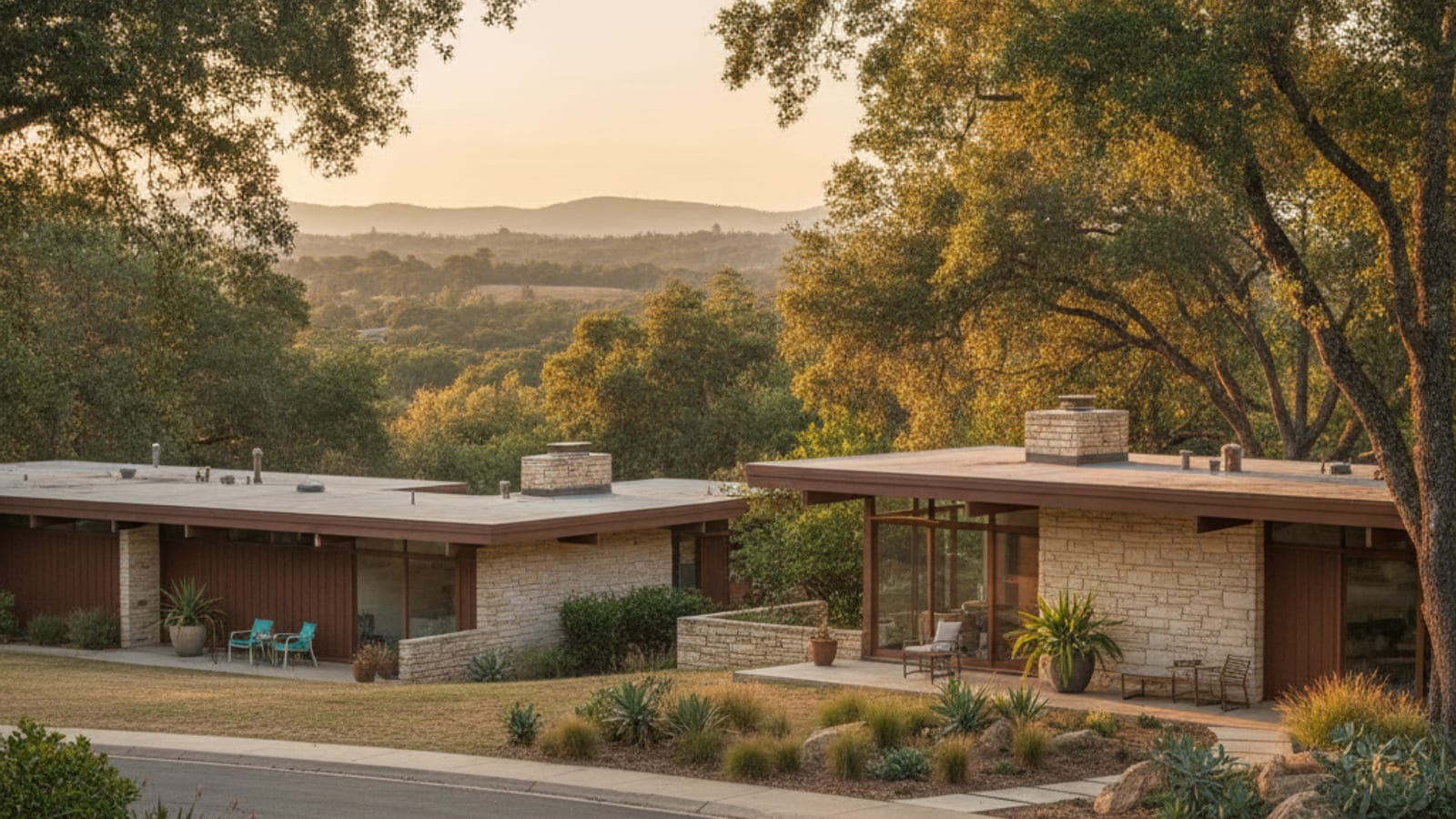
Wessynton mid-century houses have a quality that is genuinely difficult to find anywhere close to Washington, DC: the feeling, the moment you pull into the driveway, that the city is far behind you. Tall oaks close in overhead, Little Hunting Creek glints through the trees, and the house in front of you — low-slung, largely glass, cedar and brick — looks as though it grew out of the hillside rather than being placed on it. That feeling is not accidental. It is the product of a deliberate planning decision made in the 1960s, land with several centuries of layered history, and a collection of architect-designed houses that remain among the most architecturally coherent mid-century neighborhoods in Northern Virginia.
What Is the History Behind Wessynton's Land?
The land Wessynton occupies carries history that stretches well before the planned community was laid out. The Doeg people — an Algonquian-speaking group — inhabited this stretch of the Potomac watershed for generations before European settlement, and the confluence of Little Hunting Creek and the Potomac was a place of sustained human activity long before any colonial deed was written.
By the eighteenth century, the tract had become part of the broader Mount Vernon landholdings associated with George Washington; the Mount Vernon estate and its surrounding lands shaped the character of this entire corner of Fairfax County in ways that still register in the landscape today — the mature tree canopy, the generous lot lines, the absence of strip development along the creek corridors. When the Wessynton development was planned in the early 1960s, the developers chose to work with that landscape rather than clear it, a decision that set the neighborhood apart from nearly every contemporaneous subdivision in the region.
Wessynton Mid-Century Houses: The 1960s Contemporary Houses Themselves
The houses are the heart of the experience. Wessynton was designed as a planned community with architect involvement, and the results are visible on every block: flat or low-pitched roofs, deep overhangs, floor-to-ceiling glass on the garden-facing elevations, natural cedar siding left to weather or stained rather than painted, and brick used as a grounding material at the base and in fireplaces.
Many houses are oriented to draw the wooded lot into the interior — a wall of glass in the living room frames a stand of tulip poplars the way a painting frames a landscape. Carports rather than enclosed garages preserve the horizontal profile. Interior spaces flow openly from one to the next, a formal expression of the era's conviction that living and the outdoors should not be separated by opaque walls.
The community's planning philosophy — the tree-preservation commitments, the setback rules, the architectural review that keeps additions in character — is covered in depth in the Wessynton neighborhood guide, which also addresses the two homeowner associations, water access, and the resale process. What the plan preserved, in short, is the tree canopy and the sense of enclosure that makes Wessynton feel unlike any other neighborhood with an Alexandria address.
What to Inspect Before Buying a Mid-Century House in Wessynton
A 1960s house on a wooded lot beside a creek is a genuinely rewarding thing to own, and a genuinely complex one to buy. The inspection checklist for a Wessynton house is longer and more specific than for a conventional colonial or townhouse. Here is what deserves close attention:
- Roof. Flat and low-pitched roofs — common throughout Wessynton — drain differently from steep-pitch roofs and require different membrane systems. Original built-up tar-and-gravel roofs from the 1960s are well past their design life. Ask for documentation of any replacement, the membrane type, and the date. Check interior ceilings for staining that indicates past or active leaks at parapets and drains.
- Windows and glass walls. The expansive glazing that defines these houses was almost always single-pane when built. Replacement with double- or triple-pane units in period-appropriate frames is the standard upgrade, but verify that it has been done — and done with frames that respect the original sightlines. Aluminum frames from the 1960s conduct cold readily; condensation and rot at the rough opening are common findings.
- Insulation. Mid-century construction in this region relied on minimal insulation by current standards. Walls often have little or no cavity insulation; attic insulation, if any, is likely to be compressed and degraded. An energy audit before closing is worth the cost, and blown-in or spray-foam retrofits are typically achievable without disturbing interior finishes.
- Heating and cooling. Radiant floor heating, electric baseboard systems, and early forced-air installations are all found in Wessynton houses. Radiant systems are comfortable and quiet but expensive to repair if a loop fails. Confirm the current system type, age, and service history, and budget for ductwork or mini-split additions if the existing system cannot handle the glazed elevations in summer.
- Drainage and grading on a wooded lot. Mature trees and decades of leaf litter raise the grade around foundations. Walk the perimeter and look for soil that slopes toward the house, downspouts that discharge against the foundation wall, and window wells that collect rather than drain water. Crawl-space moisture is a related concern, particularly on lots that slope toward the creek.
- Care of large trees. The trees are a defining feature and a liability. Have a certified arborist assess the mature trees on the lot before closing — dead wood over a glass roof is a serious risk, and removal of a significant tree after purchase may require Fairfax County approval depending on its size and species.
- Floodplain and Resource Protection Area rules. Wessynton lots that back to Little Hunting Creek or sit in low-lying positions near the water fall within Fairfax County's regulatory framework. The county's Floodplain Management program administers the Federal Emergency Management Agency's flood maps, and some lots carry Zone AE or Zone X designations that affect flood insurance requirements. Separately, Virginia's Chesapeake Bay Preservation Act establishes a Resource Protection Area (RPA) — a 100-foot buffer landward of tidal waters and their tributaries — within which grading, clearing, construction, and even certain landscaping activities require county approval. Fairfax County's Department of Planning and Development administers both programs. A buyer should confirm the lot's flood zone designation and RPA boundary on the county's GIS system before making commitments about any renovation, addition, or landscape change.

The Fairfax County Market Context for Wessynton Buyers
Wessynton sits in Fairfax County with Alexandria mailing addresses (ZIP code 22309), so buyers should understand both jurisdictions' market conditions. Bright MLS reported that Fairfax County recorded a median sold price of $749,750 in September 2026, up 5.6 percent compared with a year earlier, with 897 closed sales and a median of 16 days on market. In the week ending October 25, 2026, Fairfax County had 2,228 active listings, with a median list price of $787,000 — a meaningful year-over-year increase from $719,900 the prior year. Those county-wide figures span every price range and every community; Wessynton houses, with their lot sizes, creek adjacency, and architectural pedigree, trade on their own terms within that broader market.
Active listings across Fairfax County rose 25.9 percent year-over-year as of September 2026 according to Realtor.com via FRED, giving buyers more time to conduct thorough due diligence — a distinct advantage when the inspection list is as detailed as it is for a 1960s mid-century house. The county-wide median days on market of 36 days in September 2026, also per Realtor.com via FRED, reflects conditions across all property types; well-maintained Wessynton houses with updated systems have historically moved more quickly than that figure might suggest, because the inventory of architect-designed mid-century houses on wooded creek lots in this corridor is genuinely limited.
Renovation decisions for a house of this age and type are never simple. The post Renovate or Rebuild in Mount Vernon, VA covers the structural and financial calculus in detail, and the questions it raises apply directly to a Wessynton purchase where the bones are strong but the systems need updating.
Why Wessynton Feels Like Escaping the City
The answer is partly topographic — the community is tucked into a creek corridor that muffles road noise and keeps commercial development at a distance. It is partly historical — land that was never subdivided into quarter-acre lots retains a spatial generosity that newer neighborhoods cannot replicate. And it is partly architectural — houses designed to dissolve the boundary between interior and wooded exterior create a daily experience that genuinely reads as retreat. When light falls through a wall of glass onto a cedar floor and the view is nothing but trees and moving water, the fact that the District of Columbia is twelve miles away is easy to forget.
Navigating a purchase in a community this specific — with its dual-association structure, its RPA boundaries, its architectural review requirements, and its mid-century inspection checklist — calls for someone who knows the Mount Vernon corridor well. Working with an Alexandria real estate agent who has experience with planned communities and mid-century properties in Fairfax County will save time and prevent surprises. The house itself will reward the care you put into choosing it.
Based on information from Bright MLS for September 1, 2026 through September 30, 2026; data is reliable but not guaranteed.
Based on information from Bright MLS for October 19, 2026 through October 25, 2026; data is reliable but not guaranteed.