
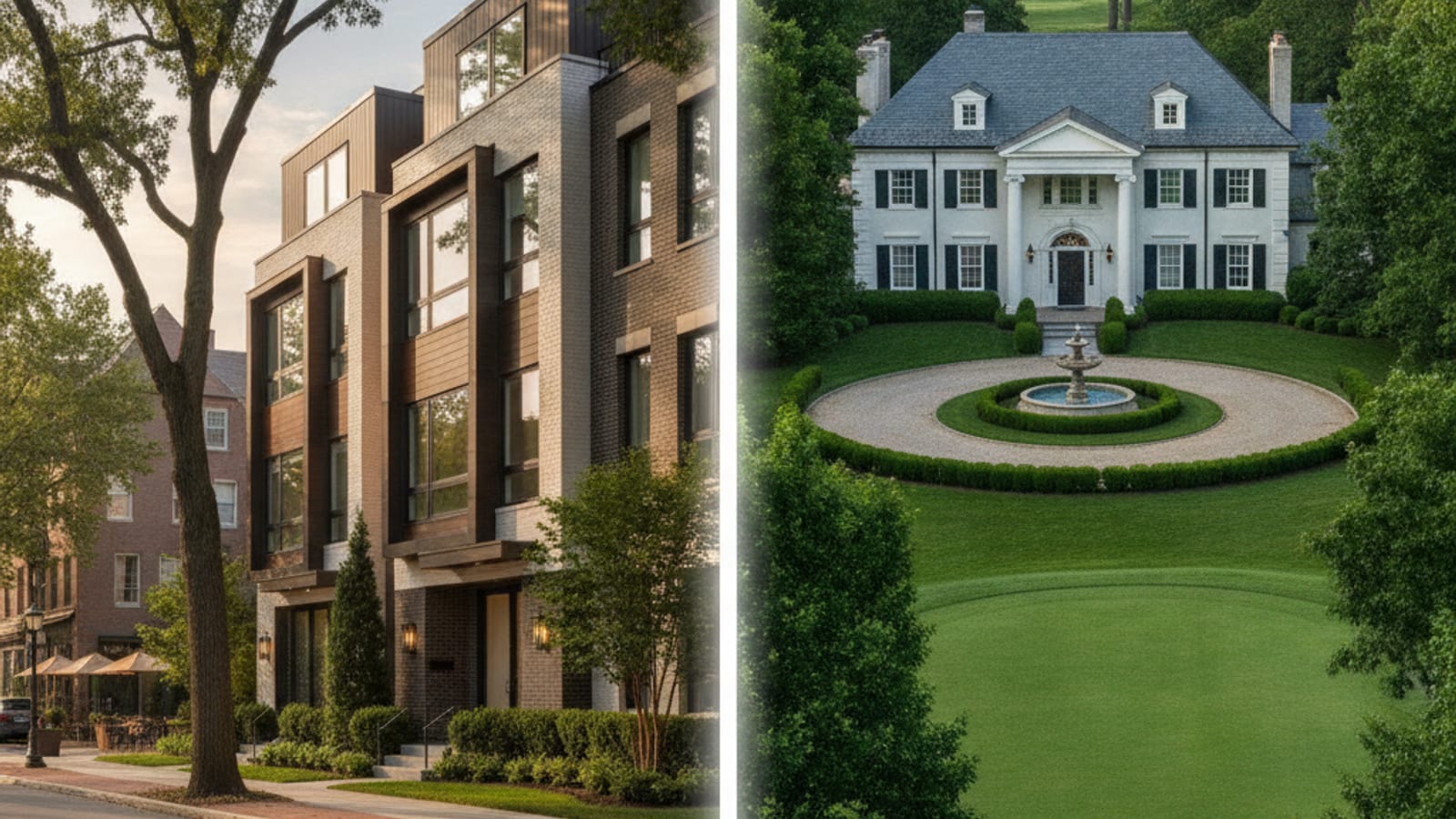
The question comes up constantly in Montgomery County's luxury market: when comparing Bethesda vs Potomac homes, how do the two actually differ? Both rank among the most expensive suburbs in greater Washington, and both are served by Montgomery County Public Schools. But the two communities are built around fundamentally different ideas of what a luxury life looks like. One delivers a walkable, metro-connected downtown energy; the other is an unabashedly private residential retreat measured in acres. The real difference is how daily life works in each place, not just what the homes themselves offer.
What Makes Bethesda Homes Worth Knowing
Bethesda's core appeal is density done well. Bethesda Row — the walkable grid along Bethesda Avenue between Arlington Road and Woodmont — and the wider downtown around it pack world-class dining, boutique retail, live music venues, and everyday services into a few square blocks. Two Red Line Metro stations — Bethesda and Medical Center — mean residents can reach downtown Washington in roughly 25 minutes without touching a steering wheel. For a commute to K Street, the NIH campus, or any downtown DC employer, that advantage compounds every single workday.
Housing variety is another differentiator. Bethesda offers a full continuum: luxury condos and co-ops starting in the mid-$500s, townhomes that run from the high $500s into the low $2 millions, and single-family homes that climb well into the $2–4 million tier in neighborhoods like Edgemoor and Chevy Chase View. That breadth means buyers can choose a condo, townhome, or single-family home without leaving Bethesda. According to research from competing market analyses, Bethesda's higher price per square foot reflects the premium many buyers place on location, convenience, and access to a denser mix of amenities — a trade-off most walkability-first buyers make willingly. If you're exploring comparable best neighborhoods for luxury homes near Washington DC, Bethesda consistently surfaces at the top of every shortlist.
What Does Potomac Offer That Bethesda Simply Cannot?
Space — and a great deal of it. Potomac's residential fabric is built on large, often heavily wooded lots ranging from one to five-plus acres, with equestrian estates and gated compounds that simply don't exist inside the Beltway. Reaching Metro means driving east to a Red Line station, and there is no walkable downtown or mixed-use corridor. Virtually every errand requires a car. For buyers who see those facts as features rather than bugs, Potomac is not a compromise — it is the destination.
Per data compiled in mid-2026 by Wydler Brothers, Potomac's median sale price sits at approximately $1,259,000, reflecting a market skewed almost entirely toward detached single-family homes on substantial grounds. Trophy properties routinely trade from $3 million to well above $10 million, particularly in the River Road and Persimmon Tree corridors. Privacy, acreage, and architectural scale are Potomac's primary currencies, and buyers who prioritize those qualities find the car-dependent trade-off entirely acceptable. For those also considering the neighboring Virginia side of the river, the Great Falls VA neighborhoods buyer's guide covers a strikingly similar estate-lot profile just across the Potomac River.
Schools: Montgomery County Public Schools in Both ZIP Codes
Both communities are served by Montgomery County Public Schools (MCPS). The distinction is at the high school level. Bethesda neighborhoods generally feed Walt Whitman High School or Bethesda-Chevy Chase High School. Potomac neighborhoods primarily feed Winston Churchill High School. School assignment is set by address, so check with MCPS which elementary, middle, and high school serve any target street.
Private school access also differs in a practical way. Bethesda addresses are a short drive — or even a Metro ride — from a cluster of DC-area private schools. Potomac residents have equally good access by car, but everything requires the car. Bethesda's Metro access makes its geography slightly more flexible for reaching those campuses.

Commute and Daily Life: The Honest Breakdown
This is where the comparison becomes most decisive for many buyers. Consider the contrast side by side:
- Metro access: Bethesda has two Red Line stations with frequent service; Potomac means driving to reach the Red Line.
- Downtown DC commute: Bethesda residents can commute by train in ~25 minutes; Potomac residents typically drive 35–55 minutes depending on traffic on I-495 or Clara Barton Parkway.
- Walkability: Bethesda Row puts restaurants, groceries, and services within a 10-minute walk of most in-town addresses; Potomac requires a car for virtually every errand.
- Day-to-day energy: Bethesda feels urban-adjacent — there is foot traffic, street life, and spontaneity. Potomac feels intentionally quiet — neighbors are separated by tree lines and long driveways.
- Lot sizes: Bethesda single-family lots typically run 7,000–15,000 sq ft; Potomac lots commonly start at one acre and scale up significantly from there.
Neither profile is superior — they are simply different settings. Bethesda makes it almost effortless to walk to the Metro on a Tuesday and host a dinner party for twenty on a Saturday. Potomac's acreage makes room for horses, a pool house, and a genuine silence that is equally irreplaceable.
Price Bands: What Your Budget Actually Buys
Understanding what each market delivers at specific price points helps buyers calibrate expectations before the first showing. With the current national 30-year mortgage rate at 6.66% as of August 2026 (Freddie Mac via FRED), financing costs are a real factor at these price levels.
In Bethesda, the $1–1.5 million range typically yields a well-finished four-bedroom colonial or craftsman on a modest in-town lot, often with recent kitchen and bath updates. The $2–3 million tier unlocks Edgemoor, Battery Park, and the estates nearest the country clubs — larger footprints, more architectural character, and better lot depth. Above $3 million, Bethesda's supply thins considerably; at the ultra-luxury level, the geography simply cannot deliver much land.
In Potomac, $1.25–2 million represents the entry to the estate market — typically a five-bedroom home on one-plus acres with mature landscaping. The $3–5 million range yields custom construction, equestrian facilities, and gated settings. Above $5 million, Potomac has no serious competition in Montgomery County: the inventory of true manor-scale properties on five-plus acres is essentially exclusive to this ZIP code. Buyers weighing these decisions will find it useful to explore current listings directly through the Bethesda, MD homes for sale page, where active inventory reflects real-time market conditions.
Bethesda vs Potomac Homes: The Bottom Line
After working through the data, the differences tend to sort cleanly. Bethesda is the right choice if you want Metro-accessible commuting, a walkable weekend routine, a broader range of entry price points, and proximity to Bethesda's own restaurant and cultural scene. Potomac is the right choice if privacy, acreage, architectural scale, and a retreat-from-the-world residential setting are non-negotiable. It offers equestrian properties and room for outdoor living, and the home itself — not its neighborhood walkability — is the primary statement.
Both communities are genuinely among the most expensive DC suburbs, and both hold value exceptionally well over time. The decision is rarely about quality; it is almost always about setting. Knowing which version of luxury living you want — connected or contemplative — makes the choice straightforward. If you are still weighing Virginia alternatives that share Potomac's estate character, the Great Falls VA neighborhoods guide is a natural next read.